
Major Victory for Vulnerable Youth as Newsom Signs AB 2524, Expanding Access to Employment
PESA-sponsored legislation creates new work permit pathways for foster and justice-involved youth, aiming to reduce
Press Release Disclaimer: This is a press release distributed through the XPR Media network. It has not been independently verified by our newsroom.
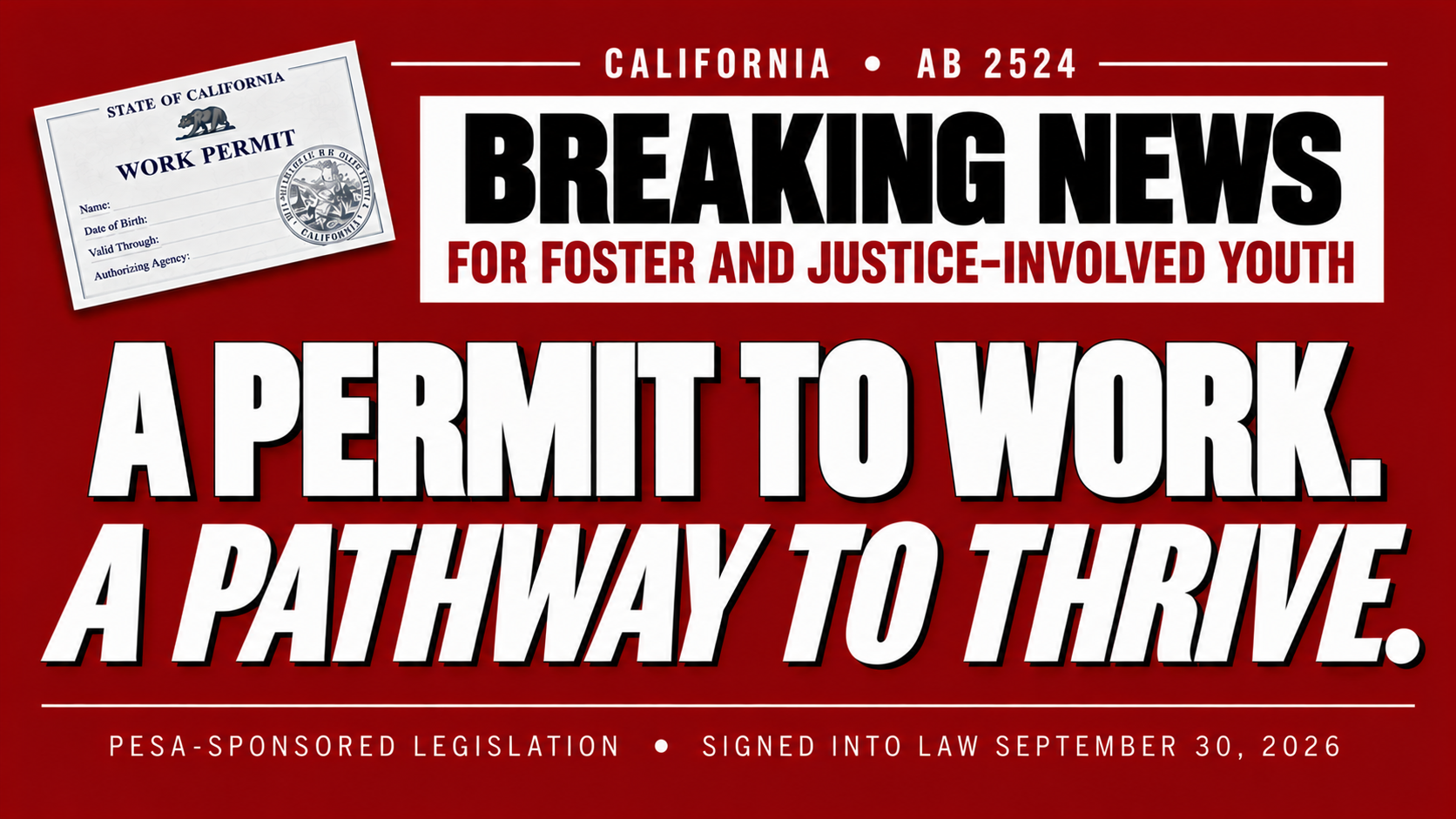

PESA-sponsored legislation creates new work permit pathways for foster and justice-involved youth, aiming to reduce homelessness, poverty, and exploitation.
LOS ANGELES, CA, UNITED STATES, October 13, 2026 /EINPresswire.com/ — California has taken a significant step toward addressing employment barriers that leave foster and justice-involved youth vulnerable to poverty, homelessness, and exploitation. On September 30, Governor Gavin Newsom signed Assembly Bill 2524 into law, expanding access to work permits for young people involved in California’s foster care and juvenile justice systems.
The legislation, authored by Assemblymember Mike A. Gipson (D-Carson) and sponsored by the nonprofit Parents, Educators/Teachers & Students in Action (PESA), received unanimous legislative approval. Effective January 1, 2027, the law establishes an alternative to the traditional school-based work permit process for eligible youth under juvenile court jurisdiction.
Removing Barriers to Lawful Employment
Under existing California law, minors generally obtain work permits through their schools, with a written application from a parent, guardian, foster parent, caregiver, or other authorized adult. For youth moving between foster homes, group homes, and other placements, changing school districts, inconsistent attendance, and disrupted relationships with school personnel can complicate an already challenging process.
AB 2524 expands both who may request work permits and who is authorized to issue them. Under the new law, educational rights holders and attorneys representing eligible youth may submit permit requests, while county probation departments and county child welfare agencies are newly authorized to review and issue work permits to qualifying youth under their jurisdiction. These agencies are particularly well-positioned to facilitate the process because of their ongoing case-management relationships with youth, caregivers, and service providers. Beyond issuing permits, they can help coordinate applications, engage caregivers, and connect young people with workforce development resources. Their direct involvement in each youth’s well-being and long-term outcomes creates opportunities to integrate employment access into broader individualized support plans.
The law preserves existing child labor protections, educational requirements, and school oversight while creating a more accessible pathway to lawful employment for eligible youth under age 18.
Addressing Homelessness, Exploitation, and Economic Instability
For youth approaching adulthood without stable family or financial support, access to legitimate employment can be critical to establishing both independence and personal safety. A national study examining foster youth found that 29% had experienced homelessness by age 21. Full-time employment, educational attainment, and supportive adult connections were among the protective factors associated with reduced homelessness risk.
For young people transitioning out of group homes or juvenile justice placements, limited access to legitimate income can compound vulnerability to housing insecurity, financial exploitation, human trafficking, and involvement in unlawful economic activities. By expanding work permit access, AB 2524 aims to address these vulnerabilities earlier, providing young people with additional opportunities to earn income, develop job skills, and establish financial stability.
Building Self-Sufficiency and Stronger Communities
The potential benefits extend beyond wages. Employment can foster self-confidence, resilience, personal responsibility, and meaningful connections with supportive adults and the broader community. These experiences can help young people develop a sense of belonging, optimism, and greater control over their futures. The legislation also creates opportunities for stronger collaboration among schools, probation departments, child welfare agencies, and community workforce programs. By sharing responsibility for employment access and youth development, participating agencies may strengthen educational engagement, improve case-management outcomes, and reduce reliance on costly crisis interventions over time, aiming to save taxpayer resources. For communities disproportionately affected by poverty and justice-system involvement, these partnerships represent an opportunity to build stability and opportunity from the residents within.
From Legislative Victory to Statewide Implementation
PESA originated the legislative concept through its direct work with foster and justice-involved youth, brought the proposal to Assemblymember Gipson, and led advocacy efforts supporting its passage. With the law taking effect January 1, 2027 PESA is preparing to support county probation departments and child welfare agencies interested in adopting the new permitting process.
Although PESA will not issue permits, the organization plans to provide technical assistance, education, and implementation guidance to help agencies understand the legislation, prepare personnel, and integrate employment opportunities into existing youth services.
PESA intends to conduct proactive statewide outreach to encourage efficient, widespread adoption, with a longer-term vision of informing similar workforce access initiatives nationally. County probation departments, child welfare agencies, and youth-serving organizations interested in implementation assistance are encouraged to contact PESA directly.
A Collaborative Legislative Achievement
PESA recognizes Assemblymember Gipson and his legislative team, including Andrew Aldama, Christopher Hernandez, and Sean Wilson, for their leadership and collaboration.
The organization also acknowledges retired Judge David Wesley, Mikki Cichocki, Dan Sackham, and Billie Belabin, along with the educational, child welfare, and community organizations that supported the legislation.
About PESA
Parents, Educators/Teachers & Students in Action (PESA) is a California nonprofit organization dedicated to youth advocacy, education, prevention, and intervention. Through direct services, community partnerships, and legislative advocacy, PESA works to remove systemic barriers and expand opportunities for vulnerable youth and families.
Seymour Amster, Esq.
PESA
seymour.amster@pesa-edu.org
Visit us on social media:
Instagram
Legal Disclaimer:
EIN Presswire provides this news content “as is” without warranty of any kind. We do not accept any responsibility or liability
for the accuracy, content, images, videos, licenses, completeness, legality, or reliability of the information contained in this
article. If you have any complaints or copyright issues related to this article, kindly contact the author above.

Media gallery
